
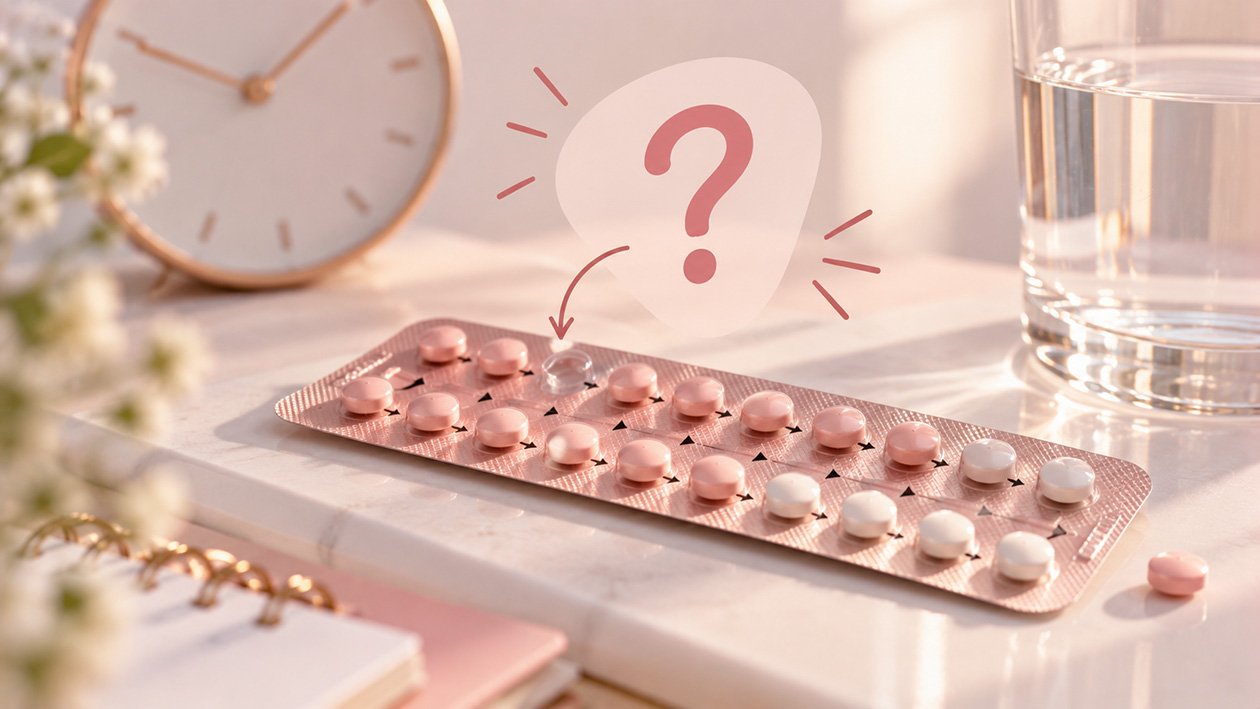
Missed Your Birth Control Pill? Here's What You Should Do
Athanasia Despotidi, MD, MSc
Obstetrician & Gynecologist
Specialist in Assisted Reproduction
Forgetting to take your birth control pill is something that can happen to anyone. In most cases, the situation can be managed easily, provided you know what steps to take.
The most important things to consider are which type of pill you take, how much time has passed since your scheduled dose, and where you are in your pill pack.
Instructions vary depending on the active ingredient and dosing schedule. For this reason, it is important to follow the specific instructions provided with your medication.
First: Which Type of Birth Control Pill Do You Take?
There are two main types of oral contraceptive pills.
Combined oral contraceptive pills
Combined pills contain two hormones: an estrogen and a progestogen.
Some are taken for 21 days followed by a pill-free interval, while others contain more active pills and may include inactive tablets.
The dosing schedule matters when a pill is missed.
Progestogen-Only Pills
Progestogen-only pills, often called mini-pills, do not contain estrogen. mini-pill.
Depending on the active ingredient, such as norethisterone, desogestrel, or drospirenone, different time limits apply when a pill is taken late.
If you are unsure which type of pill you use, check the packaging or ask your gynecologist or pharmacist.
What Should I Do If I Miss a Combined Birth Control Pill?
The following recommendations apply to many commonly used combined oral contraceptives. Some formulations, particularly those with varying hormone doses throughout the pack, have different instructions.
If One Active Pill Is Less Than 48 Hours Late
- Take the missed pill as soon as you remember.
- Continue taking the remaining pills at your usual time.
- You may need to take two pills on the same day.
- Additional contraceptive protection is usually not necessary.
In this situation, contraceptive effectiveness is generally maintained.
If at least 48 hours have passed since the first missed pill was due:
- Take the most recently missed pill as soon as possible.
- Discard the earlier missed pills.
- Continue taking the remaining pills as scheduled.
- Use condoms or avoid sexual intercourse until you have taken active pills for seven consecutive days..
If the missed pills occurred near the end of the active pills, you may need to skip the usual If the missed pills occurred near the end of the active pills, you may need to skip the usual pill-free interval or inactive tablets and start the next pack immediately.pill-free interval or inactive tablets and start the next pack immediately.
If the missed pills occurred at the beginning of the pack and you had sexual intercourse without additional protection during the previous five days, emergency contraception may be necessary.
What If I Miss an Inactive Pill?
Some pill packs contain inactive tablets, also known as placebo pills, which do not contain contraceptive hormones. placebo, τα οποία δεν περιέχουν αντισυλληπτικές ορμόνες.
If you miss an inactive pill, you can simply skip it.
Missing an inactive pill does not reduce contraceptive protection, provided you start the next active pills on the scheduled day.
What Should I Do If I Miss a Progestogen-Only Pill?
Instructions depend on the active ingredient.
Pills With a Three-Hour Window
Some traditional progestogen-only pills, including formulations containing norethisterone or norgestrel, have a three-hour window.
If you are more than three hours late:
- Take the missed pill as soon as you remember.
- Continue taking your remaining pills as scheduled.
- Use condoms for the next 48 hours.
If you have recently had sexual intercourse without additional protection, seek advice about emergency contraception.
Pills Containing Desogestrel
Desogestrel-only pills generally have a 12-hour window.
If you are less than 12 hours late, take the pill as soon as you remember and continue your usual schedule.
If you are more than 12 hours late, take the missed pill as soon as possible and follow the specific instructions for your medication regarding additional contraception.
For certain desogestrel formulations, the product instructions recommend using condoms for seven days after a missed pill.
Pills Containing Drospirenone
Drospirenone-only pills have a different dosing schedule and specific instructions for missed doses.
For some commonly used regimens, if one active pill is less than 48 hours late, taking it as soon as you remember is usually sufficient.
If two or more consecutive active pills are missed, additional contraception may be required for seven days.
Because instructions can vary between formulations, always follow the patient information leaflet supplied with your medication.
When Might Emergency Contraception Be Necessary?
Emergency contraception may be needed if you have missed contraceptive pills and had sexual intercourse without adequate contraceptive protection.
The same may happen if you experience severe or prolonged diarrhea.
The relevant time interval and the need for additional contraception depend on the type of pill.
If this happens, check your medication instructions and contact your gynecologist or pharmacist for advice.
When Might Emergency Contraception Be Necessary?
Emergency contraception may be needed if you have missed contraceptive pills and had sexual intercourse without adequate contraceptive protection.
The decision depends on:
- The type of contraceptive pill.
- The number of pills missed.
- When the missed doses occurred.
- When sexual intercourse took place.
Emergency contraception options include levonorgestrel, ulipristal acetate, and the copper intrauterine device (IUD).
The most appropriate option depends on your medical history and the time elapsed since intercourse.
It is also important to know that some emergency contraception methods affect when you should restart your regular hormonal contraceptive pill.
If you think you may need emergency contraception, seek medical or pharmaceutical advice without delay.
Is Bleeding Normal After Missing a Pill?
Missing contraceptive pills may cause light bleeding or spotting between periods.
This is relatively common and usually does not indicate a serious problem.
However, if the bleeding is heavy, prolonged, or accompanied by significant pain, medical evaluation is recommended.
When Should I Take a Pregnancy Test?
If you have missed contraceptive pills and had sexual intercourse when your contraceptive protection may have been reduced, a pregnancy test may be necessary.
A urine pregnancy test is generally reliable when performed at least 21 days after the sexual intercourse in question.
Missing your expected withdrawal bleed does not necessarily mean you are pregnant. However, if you have missed pills, the possibility of pregnancy should be considered.
How Can I Avoid Forgetting My Pill?
A few simple habits can help:
- Set a daily reminder on your phone.
- Take your pill at the same time every day.
- Link taking your pill to an established daily routine.
- Make sure you have your next pack ready before the current one runs out.
If you frequently forget to take your pill, you may wish to discuss other hormonal contraceptive methods that do not require daily administration with your gynecologist.
The most suitable method should be selected individually, taking into account your medical history, personal preferences, and contraceptive needs.
Conclusion
Missing a birth control pill does not necessarily mean that your contraceptive protection has been lost.
However, the appropriate steps depend on the type of pill, how late it was taken, and where you are in the pill pack.
The most important thing is to follow the instructions for your specific medication and seek timely advice whenever you are unsure or pregnancy is a possibility.
Accurate information and individualized medical guidance can help maintain contraceptive effectiveness and avoid unnecessary anxiety.
This article is intended for informational purposes only and does not replace individualized medical advice.