
HPV:Uterine Fibroids: Symptoms, Diagnosis and Treatment
Athanasia Despotidi, MD, MSc
Obstetrician & Gynecologist
Specialist in Assisted Reproduction
Uterine fibroids are benign growths that develop in the muscular wall of the uterus and are among the most common gynecological conditions.
They are particularly common during the reproductive years. Studies suggest that up to 70–80% of women may develop fibroids by the time they reach menopause, depending on the population studied and the diagnostic methods used.
In most cases, fibroids cause no symptoms and do not require treatment. However, in some women, they may affect menstrual bleeding, everyday life, or even fertility.
Having a uterine fibroid does not necessarily mean that surgery is needed. The most appropriate management depends on the individual characteristics of each case.
What Are Uterine Fibroids?
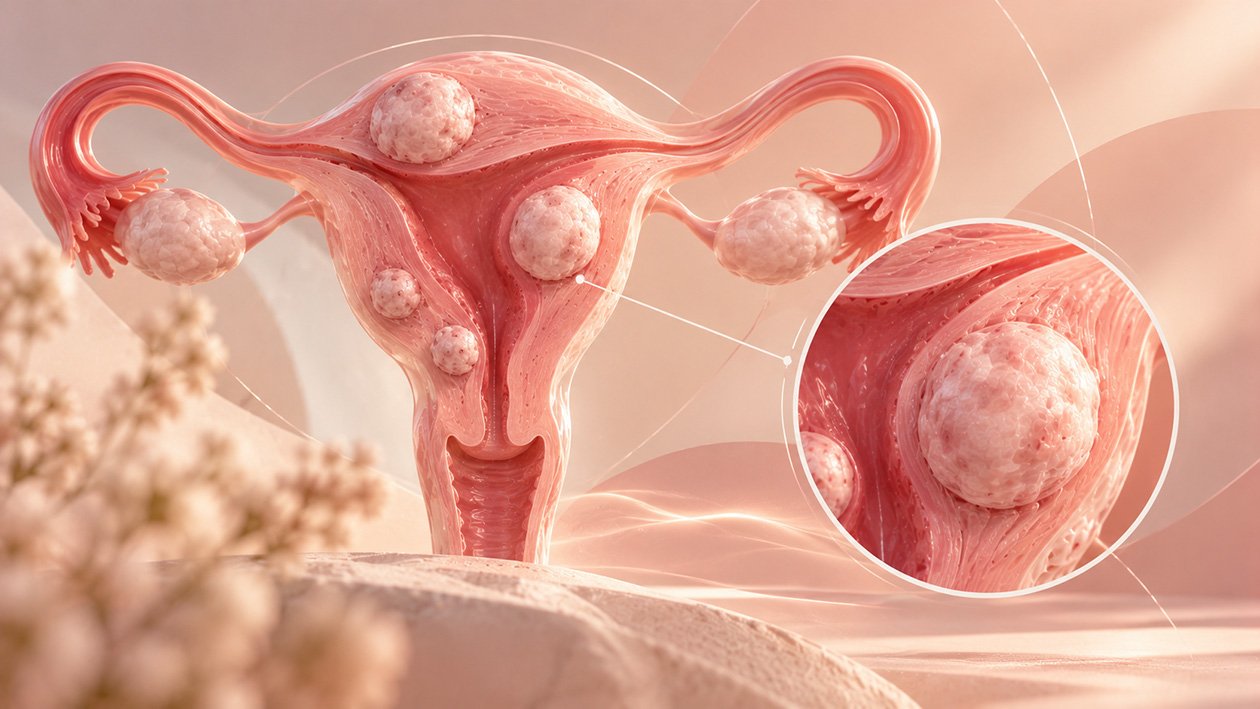
Uterine fibroids, also known as leiomyomas, are benign growths that arise from the smooth muscle cells of the uterus.
A woman may have one or several fibroids, which can vary considerably in size and location.
Depending on their position, fibroids are mainly classified as:
- Intramural fibroids: Develop within the muscular wall of the uterus.
- Submucosal fibroids: Extend towards or into the uterine cavity.
- Subserosal fibroids: Grow towards the outer surface of the uterus.
The location of a fibroid is often more important than its size, particularly when assessing abnormal bleeding or fertility.
Fibroids become more common with increasing age during the reproductive years. They are also more prevalent among women of African ancestry, while genetic and hormonal factors appear to contribute to their development.
After menopause, many fibroids remain stable or decrease in size.
What Are the Symptoms of Uterine Fibroids?
Most uterine fibroids are asymptomatic and are often discovered incidentally during a routine gynecological ultrasound examination.
When symptoms occur, they may include:
- Heavy or prolonged menstrual bleeding
- Bleeding between menstrual periods
- Iron-deficiency anemia, caused by excessive blood loss
- Pelvic pain or a feeling of heaviness in the lower abdomen
- Pelvic pressure or discomfort
- Frequent urination or difficulty emptying the bladder completely
- Constipation due to pressure on the bowel
- Difficulty conceiving or pregnancy complications in certain cases
The severity of symptoms does not depend solely on the size of the fibroids.
For example, a small submucosal fibroid may cause significant menstrual bleeding, while a larger fibroid in a different location may cause no symptoms at all.
How Are Uterine Fibroids Diagnosed?
Diagnosis is based on medical history, gynecological assessment, and, most importantly, ultrasound examination.
Transvaginal ultrasound is usually the first-line imaging investigation, as it allows the gynecologist to assess the number, size, and location of fibroids.
In certain cases, additional investigations may be recommended, including:
- Transabdominal ultrasound, particularly when the uterus is significantly enlarged.
- Saline infusion sonography or hysteroscopy, when a more detailed assessment of the uterine cavity is needed.
- Magnetic resonance imaging (MRI), in selected cases, to provide more accurate fibroid mapping and support treatment planning.
If heavy menstrual bleeding is present, blood tests may also be recommended to investigate possible anemia.
Uterine Fibroid Treatment: What Options Are Available?
The management of uterine fibroids is individualized.
Treatment decisions depend on symptoms, the size, number and location of fibroids, age, medical history, and whether the woman wishes to become pregnant in the future.
Not all fibroids require treatment, and there is no single treatment option that is suitable for every woman.
Conservative Management and Monitoring
When fibroids do not cause symptoms or affect fertility or other important aspects of health, observation without immediate treatment may be appropriate.
The need for follow-up and its frequency are determined individually, depending on clinical findings and symptoms.
Conservative management may be particularly suitable for women approaching menopause, as fibroids often decrease in size afterwards.
Medical Treatment
Medical treatment is primarily used to control symptoms, especially heavy menstrual bleeding.
Depending on the individual circumstances, options may include:
- Hormonal contraceptives, which may help regulate menstrual bleeding.
- A levonorgestrel-releasing intrauterine system (IUS), when the shape of the uterine cavity allows appropriate placement.
- Tranexamic acid, which can reduce menstrual blood loss in suitable patients.
- Nonsteroidal anti-inflammatory drugs (NSAIDs), which may help relieve pain and, in some cases, reduce menstrual bleeding.
- Specialized hormonal therapies, including treatments that act on the gonadotropin-releasing hormone (GnRH) pathway, when indicated.
The choice of treatment depends on medical history, possible contraindications, and the availability of appropriate medications.
It is important to understand that medical treatments do not necessarily eliminate fibroids.Their primary aim is often to control symptoms effectively.
Surgical and Minimally Invasive Treatments
When symptoms are significant or specific clinical indications are present, procedural or surgical treatment may be considered.
The main options include:
Myomectomy
Myomectomy involves the surgical removal of fibroids while preserving the uterus.
Depending on their location, size, and number, fibroids may be removed through hysteroscopy, laparoscopy, or open surgery.
Myomectomy is an important option for women who wish to preserve their uterus and, in appropriate cases, their ability to become pregnant in the future.
Hysterectomy
Hysterectomy is the surgical removal of the uterus and provides a definitive treatment for uterine fibroids.
It may be considered for women with severe symptoms who do not wish to become pregnant in the future, after discussing the available alternatives.
Uterine Artery Embolization
Uterine artery embolization is a minimally invasive procedure that reduces blood flow to the fibroids, aiming to shrink them and improve symptoms.
It may be considered for women with severe symptoms who do not wish to become pregnant in the future, after discussing the available alternatives.
Other Minimally Invasive Techniques
In selected cases, techniques such as radiofrequency ablation or focused ultrasound treatment may be considered.
Their suitability depends on the characteristics of the fibroids, the availability of the procedure, and the woman's reproductive plans.
When Is Surgery Necessary?
There is no specific fibroid size that automatically makes surgery necessary.
The decision to proceed with surgery is based on the overall clinical picture rather than solely on the diameter or number of fibroids.
Surgical treatment may be considered when:
- Heavy or prolonged menstrual bleeding cannot be adequately controlled with conservative treatment.
- Excessive bleeding causes significant anemia.
- Fibroids cause severe pressure symptoms or persistent pelvic pain attributable to them.
- Fibroids affect the uterine cavity and may be associated with infertility or recurrent pregnancy loss.
- Other clinical or imaging findings require further investigation or treatment.
Age, family history, and ancestry may be associated with the prevalence or severity of fibroids, but they are not, on their own, indications for surgery.
The final decision should be made through a detailed discussion between the woman and her gynecologist, taking into account her individual needs and priorities.
Uterine Fibroids and Fertility
Being diagnosed with uterine fibroids does not necessarily mean that a woman will have difficulty becoming pregnant..
Many women with fibroids conceive naturally and have uncomplicated pregnancies.
However, certain fibroids may affect fertility, mainly depending on their location and their relationship to the uterine cavity.
Submucosal fibroids, as well as some intramural fibroids that distort the uterine cavity, may interfere with embryo implantation and may be associated with lower pregnancy rates or an increased risk of miscarriage.
In contrast, subserosal fibroids generally do not have a significant effect on fertility.
For intramural fibroids that do not distort the uterine cavity, their impact on fertility and the potential benefit of surgical removal are not always clear.
In women planning a pregnancy or undergoing assisted reproductive treatment, assessment should be individualized.
Not all fibroids need to be removed before pregnancy or in vitro fertilization (IVF) treatment.
Uterine Fibroids and Pregnancy
Symptomatic uterine fibroids can significantly affect a woman's physical and emotional well-being.
However, depending on their size, number, and location, some fibroids may be associated with an increased risk of complications, including:
- Pain during pregnancy
- Abnormal fetal position or presentation
- Preterm birth
- An increased likelihood of cesarean delivery
- Postpartum hemorrhage
Having fibroids does not mean that these complications will necessarily occur. Pregnancy monitoring should be adapted to the individual circumstances.
Uterine Fibroids and Quality of Life
Symptomatic uterine fibroids can significantly affect a woman's physical and emotional well-being.
Heavy bleeding, pain, fatigue related to anemia, and pelvic pressure may interfere with work, social activities, and sexual life.
Timely assessment can help identify the cause of symptoms and guide appropriate treatment.
It is important for women to know that several treatment options are available and that management can be tailored to their individual needs.
When Should You See a Gynecologist?
A gynecological assessment is important if you experience:
- Changes in the amount or duration of menstrual bleeding
- Bleeding between menstrual periods
- Persistent pelvic pain or a feeling of heaviness in the lower abdomen
- Frequent urination or other pressure-related symptoms
- Fatigue or weakness that may be associated with anemia
- Difficulty conceiving
Important: Very heavy bleeding, particularly when accompanied by dizziness, faintness, or marked weakness, as well as sudden, severe pelvic pain, requires urgent medical assessment.
Conclusion
Uterine fibroids are very common and, in most cases, benign and asymptomatic.
Their diagnosis does not necessarily mean that treatment or surgery is required.
However, when fibroids cause symptoms or affect fertility, appropriate management can significantly improve quality of life and, in selected cases, reproductive outcomes.
Accurate information, individualized assessment, and shared decision-making with your gynecologist are essential to choosing the treatment that best meets your needs.
This article is intended for informational purposes only and does not replace individualized medical advice.